

Quick Answer
Executive coaching is a confidential, one-on-one partnership between a senior leader and a qualified coach, focused on sharpening judgment, strengthening leadership presence, and improving decision-making. Unlike workshops or training programs, it works on how a leader actually thinks and behaves inside their real role. Most engagements run between three and twelve months and are built entirely around the leader’s specific challenges, priorities, and organizational context.
Intro
There is a particular kind of pressure that only senior leaders understand. It is not the pressure of a difficult task or a demanding deadline. It is the pressure of knowing that your clarity, your judgment, and your presence shape everything around you, the decisions your team makes, the culture your organization lives, and the results your business delivers.
Most leaders carry that pressure quietly. They navigate complexity with whatever tools they developed on the way up. And many of them do it well, until the stakes grow, the environment shifts, or the demands of leadership stretch beyond what experience alone can address.
Executive coaching exists precisely for this moment. It is not a corrective measure for struggling leaders. It is a serious developmental investment for leaders who recognize that sustained high performance at the top requires honest self-examination, disciplined thinking, and the willingness to keep growing.
What Is Executive Coaching?
Executive coaching is a confidential, structured partnership between a senior leader and a qualified coach, designed to sharpen judgment, strengthen leadership presence, and support the kind of sustained performance that drives real organizational impact.
It is not leadership training in the traditional sense. Workshops and programs transfer knowledge. Executive coaching transforms the way a leader thinks, decides, and operates, through rigorous self-reflection, honest feedback, and ongoing accountability.
The work happens in private. It is grounded in the leader’s actual context, their strategic priorities, their organizational dynamics, the relationships they must navigate, and the behavioral patterns that either serve or limit their effectiveness. No two coaching engagements look the same, because no two leaders carry exactly the same challenges.
What distinguishes executive coaching from other forms of professional support is its focus on depth rather than breadth. It does not attempt to fix everything at once. It identifies the few critical areas where a shift in thinking or behavior would produce the most meaningful improvement, and it builds on those, consistently and deliberately, over time.
What Does an Executive Coach Do?
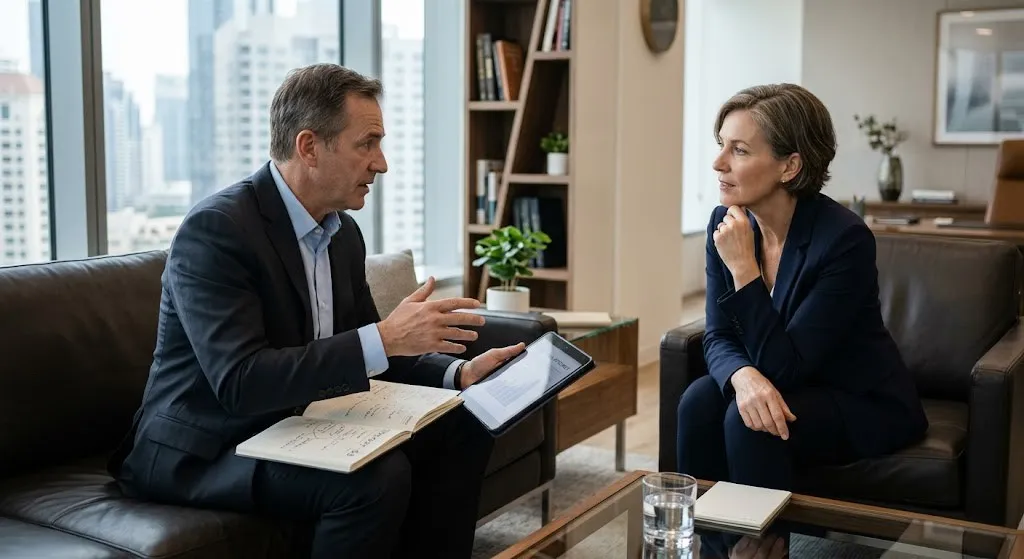
An executive coach does not tell leaders what to do. That distinction matters enormously. The role of a coach is not to hand over answers. It is to create the conditions where a leader can think more clearly, see themselves more honestly, and make better decisions as a result.
In practice, this means a coach helps a leader examine how they approach decisions, not just what decisions they make. It means surfacing the assumptions, habits, and emotional patterns that operate beneath the surface and often drive outcomes more powerfully than conscious strategy.
A coach supports leaders in developing stronger executive presence, meaning the ability to communicate with clarity and authority, to hold composure under pressure, and to influence stakeholders without resorting to positional power. They help leaders build emotional intelligence, not as a soft skill to check off, but as a precise operational capability that shapes how a team functions and how an organization responds under stress.
A good coach also provides what most leaders rarely get at the top: honest, skilled, confidential challenge. People who report to senior leaders are rarely in a position to tell them the whole truth. A coach is.
Who Needs Executive Coaching?
The leaders who benefit most from executive coaching are almost never the ones who are failing. They are the ones who are already performing at a high level and recognize that the demands on them are only growing.
CEOs and C-suite executives navigating strategic complexity and board accountability. Managing Directors who need to align culture with business direction and translate leadership intent into measurable outcomes. Senior leaders stepping into expanded responsibility, where the skills that earned the promotion may not be sufficient for what the new role demands. Founders and entrepreneurs who have built something real and now face the organizational challenges that come with scale. And high-potential leaders being developed deliberately for future executive roles.
What these leaders share is not a performance problem. It is an awareness that leadership at altitude is different from anything that preceded it, and that operating at that level, sustainably and effectively, requires a different kind of investment.
Why Executive Coaching Matters in Today’s Workplace
The environment that today’s leaders operate in has changed in fundamental ways. Complexity is not seasonal, it is the permanent condition. Stakeholder expectations are more layered. The pace of change demands judgment calls with incomplete information. The pressure to deliver results while maintaining culture, retaining talent, and managing upward and outward simultaneously is real and relentless.
Against that backdrop, the leadership gaps that produce the most costly outcomes are rarely technical ones. Leaders rarely underperform because they lack knowledge of their industry or their function. They underperform because of how they manage themselves under pressure, how they communicate during uncertainty, how they respond when trust is fractured, or how they make decisions when the right answer is genuinely unclear.
These are the gaps executive coaching is designed to address. And they are the gaps that no amount of additional information or formal training fully resolves, because they are not knowledge problems. They are behavioral and psychological ones.
Leadership Challenges Executive Coaching Resolves
The most common issues that bring senior leaders to executive coaching are predictable, not because the leaders lack capability, but because the dynamics of senior leadership generate them systematically.
Decision fatigue and decision avoidance are common. Leaders at the top face more consequential choices, under greater ambiguity, than any other level of the organization. The weight of that compounds over time, and without structured reflection, judgment suffers.
Team dynamics and conflict at the leadership level create disproportionate organizational damage. A fractured executive team does not stay contained, it cascades. Coaching helps leaders understand their contribution to team dynamics and develop the capacity to lead through tension constructively.
Communication breakdown between senior leaders and their organizations is another persistent challenge. The further up a leader sits, the more their communication is interpreted, filtered, and misread, and the greater the consequence when the message does not land. Coaching builds precision in how leaders communicate and heightens their awareness of impact.
Burnout and the erosion of long-term performance capacity. Senior leaders rarely acknowledge fatigue until it has already compromised their effectiveness. Coaching creates the space to examine how sustainable current ways of working actually are, and to build the self-awareness and systems that support enduring performance.
Leading organizational change, specifically the challenge of guiding an organization through transformation while maintaining continuity, managing resistance, and holding people’s confidence through uncertainty. This is among the most demanding things a leader is ever asked to do. Coaching provides the steady, private space where leaders can process, recalibrate, and lead with greater clarity.
Key Benefits of Executive Coaching
Improved Leadership Effectiveness
The first place most leaders experience change through coaching is in how they lead, not in what they know, but in how they operate. Delegation becomes more deliberate. Communication becomes cleaner and more intentional. The habitual patterns that limit effectiveness, micromanagement, avoidance, inconsistency, become visible and therefore changeable. Leaders who complete substantive coaching engagements consistently report that the quality of their working relationships improves, their confidence in navigating ambiguous situations increases, and their ability to motivate and mobilize their teams grows.
Stronger Self-Awareness
Self-awareness is not a personality trait. It is a developed capacity, and it is arguably the most important capability a senior leader can have. Leaders who understand how their own emotional states, assumptions, and behavioral patterns affect others are better positioned to make clear decisions, maintain productive relationships, and respond to challenges in ways that build rather than damage trust. Coaching builds this capacity through sustained honest reflection and structured feedback. It makes visible what experience and intelligence alone rarely reveal.
Sharper Decision-Making
At senior levels, the decisions that matter most are rarely the ones where the right answer is obvious. They are the judgment calls made under conditions of ambiguity, competing priorities, and incomplete information, where how a leader thinks is as consequential as what they decide. Executive coaching develops more disciplined strategic thinking, more rigorous risk assessment, and a cleaner ability to distinguish between what is urgent and what is genuinely important. Leaders who have worked through their decision-making patterns with a skilled coach make fewer reactive decisions and more considered ones.
Elevated Team Performance
A leader’s impact on their team is rarely direct. It operates through the environment they create, through the clarity they provide, the standards they hold, the trust they build, and the culture they model. Leaders who develop through executive coaching consistently create conditions where their teams perform at a higher level, not because the team members changed, but because the leader’s influence on the environment shifted in ways that unlocked greater collective capability. Team engagement, alignment, and accountability all improve when the leader at the top is operating with greater intentionality.
Executive Presence and Professional Standing
Executive presence is not about charisma or volume. It is the quality of being someone whose leadership is felt, someone who communicates with authority and clarity, who holds composure in high-pressure situations, and whose influence operates through credibility and trust rather than position alone. Coaching builds this quality deliberately. It strengthens how leaders carry themselves in high-stakes conversations, how they project confidence during uncertainty, and how they are perceived by boards, stakeholders, and peers.
Organizational Performance
The most durable benefit of executive coaching does not live in the leader’s experience of the engagement. It lives in the organizational outcomes that follow. When senior leaders operate with greater clarity, their strategic direction becomes cleaner. When they communicate with more precision, alignment improves. When they manage themselves more effectively under pressure, the teams around them function with less turbulence. The return on a substantive executive coaching engagement is measurable, in culture, in capability, and in results.
The Executive Coaching Process Explained
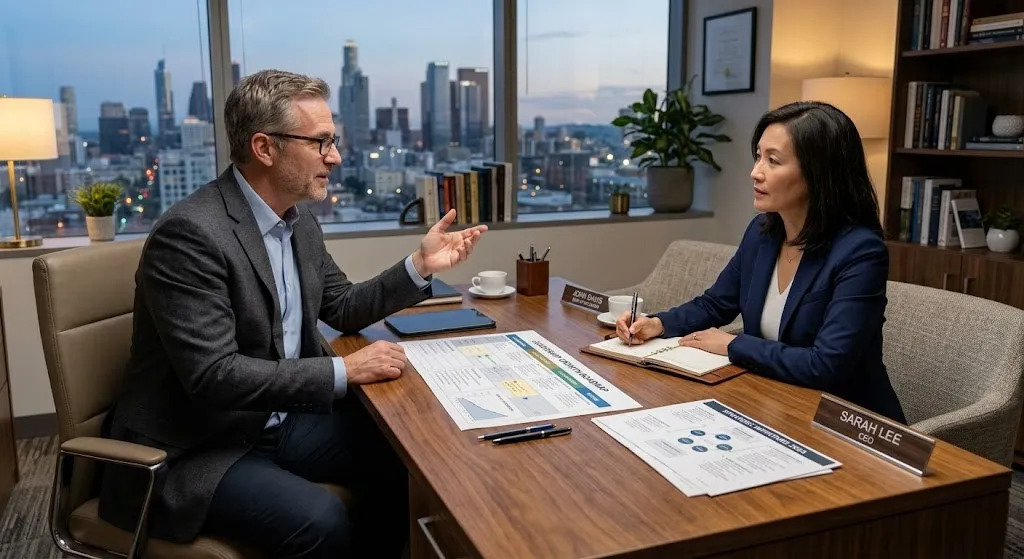
Step 1: Initial Assessment and Goal Setting
Every substantive coaching engagement begins with a diagnostic phase. This is not a brief i take conversation. It is a serious examination of the leader’s context, their role, their strategic responsibilities, the organizational dynamics they operate within, and the specific challenges that coaching is intended to address.
At this stage, a skilled coach works to understand not just what the leader wants to achieve, but the broader system they are operating in, the stakeholder expectations, the cultural conditions, the performance pressures, and the behavioral patterns that are most relevant to the work ahead. A good assessment surfaces both what the leader identifies and what they may not yet see clearly. This diagnostic clarity is what makes the coaching purposeful rather than generic.
Step 2: Personalized Coaching Plan
Based on the assessment, the coach and leader co-develop a focused development plan. This is not a checklist of competencies. It is a strategic framework for the engagement, defining the specific areas of focus, the behavioral shifts that would produce the greatest leadership impact, and the measures by which progress will be evaluated.
The best coaching plans are lean and precise. They prioritize a small number of high-leverage areas rather than attempting to address everything simultaneously. And they are grounded in the leader’s real organizational context, not abstract leadership theory.
Step 3: One-to-One Executive Coaching Sessions
The coaching itself happens in private, structured sessions between the coach and the executive. These are not performance reviews or status checks. They are the disciplined, confidential space where a leader can think out loud, be challenged on their assumptions, examine their behavior honestly, and develop new patterns of thinking and action.
Sessions typically occur regularly over the course of the engagement, often monthly or bi-monthly at senior levels, with the frequency calibrated to the intensity of the work and the demands on the executive’s time. The quality of these sessions depends entirely on the depth of the relationship and the honesty it enables.
Step 4: Progress Tracking and Accountability
Coaching without accountability is reflection without consequence. The most effective engagements are structured to track behavioral change over time, not through bureaucratic measurement, but through honest ongoing assessment of whether the shifts the leader set out to make are actually taking hold in their real leadership practice.
This is where accountability becomes a core part of the coaching relationship. A skilled coach holds leaders to their commitments, names patterns that resurface, and creates the productive friction that keeps development moving rather than stalling.
Step 5: Long-Term Leadership Development
The mark of a successful coaching engagement is not what changes during the sessions. It is what endures afterward. The goal is to build leadership capability that is genuinely internalized, that becomes part of how the leader thinks and operates, independent of the coaching relationship.
This means the final phase of any serious engagement is devoted to integration: consolidating the growth that has occurred, identifying the conditions that will support continued development, and ensuring the leader is equipped to sustain what they have built.
Real Examples of Executive Coaching Success
Example 1: The Executive Who Was Technically Brilliant but Hard to Follow
A senior executive at a financial services firm had a sharp strategic mind and a strong track record of results. But their leadership team was consistently disengaged in strategic conversations, decisions were being made without adequate buy-in, and the executive could not understand why alignment was so difficult to build.
The coaching process surfaced a clear pattern: the executive arrived at conclusions privately, communicated them as directives, and experienced pushback as either resistance or incompetence. The issue was not strategy. It was the assumption that clarity for the leader translated automatically into clarity for the team.
Through coaching, the executive developed a more consultative communication approach, creating genuine space for input before conclusions were reached, rather than after. Within two quarters, leadership team meetings shifted from compliance-oriented to genuinely collaborative. Alignment improved. And the executive reported that decisions, once actually bought into, were implemented with significantly more energy and speed.
Example 2: The High Performer Who Struggled to Lead
A manager with an outstanding individual track record was promoted into a senior leadership role. The promotion was well-earned on paper. But within months, the pattern that plays out in so many organizations was unfolding: the new leader was taking work back from their team, finding it faster to do things themselves, and growing increasingly frustrated that no one seemed to perform to the standard they had personally set.
Coaching identified the core dynamic, this leader’s identity and self-worth were still tied to being the person with the answers. They had not yet made the psychological shift from individual contributor to leader: from personal output to collective outcomes.
The coaching work focused on helping this leader understand what enabling actually looks like, how to develop their team rather than replace them, and how to find meaning and satisfaction in results that came through others. The shift did not happen overnight. But it happened, and the team’s confidence, capability, and output transformed as a result.
Example 3: The CEO Navigating Organizational Change
A CEO was leading a significant organizational restructure. Strategically, the direction was sound. But the communication during the process was generating anxiety across the organization, trust in leadership was eroding, and the CEO was increasingly isolated at a moment when connection to their people was critical.
Coaching provided the steady, confidential space for the CEO to process the complexity of what they were navigating, without the performance pressure of doing so in front of their team or their board. It helped them understand how they were being perceived versus how they intended to come across, and to develop a more deliberate and human communication approach during the uncertainty of transition.
By the time the restructure was complete, the CEO had rebuilt meaningful trust with their leadership team. The narrative around the change had shifted, from something being done to the organization, to something being built with it.
Executive Coaching vs Mentoring vs Consulting
These three forms of professional support are frequently conflated. They are distinct in important ways, and choosing between them depends on what a leader actually needs.
Executive Coaching
Coaching is focused on the leader’s own development, their thinking, their behavior, their self-awareness, and their effectiveness. A coach does not provide answers. They create the conditions where the leader discovers them. The insight is the leader’s. The accountability is the leader’s. The coach’s role is to facilitate that process with skill and rigor.
Coaching is appropriate when the issue lies in how a leader leads, not in what information they need or what decisions need to be made on their behalf.
Mentoring
Mentoring draws on the mentor’s personal experience and expertise. A mentor shares what they have learned, offers perspective shaped by what they have lived, and guides based on their own path. It is a generative, often long-term relationship grounded in wisdom and genuine investment in the mentee’s growth.
Mentoring is valuable for navigating career transitions, building domain knowledge, and developing through proximity to someone who has walked a similar path. It is not the same as coaching, because the insight travels primarily from mentor to mentee, rather than being drawn out of the leader themselves.
Consulting
A consultant brings expertise to solve a specific problem. They assess, diagnose, and recommend, and often, they implement. The value is in their knowledge and their solutions, not in developing the client’s own capabilities.
Consulting is appropriate when an organization needs a specific answer, a defined deliverable, or a problem solved by someone with specialized expertise. It is not a substitute for developing the leader’s own capability to think through and navigate similar problems in the future.
Which Option Is Right for You?
If what you need is honest, skilled support to develop as a leader, to think more clearly, lead more effectively, and grow your impact, executive coaching is the right investment. If you want perspective from someone who has walked a similar path, mentoring is worth seeking. If you have a specific business problem that requires outside expertise and a defined solution, bring in a consultant.
Many leaders benefit from all three at different points. The key is knowing which one addresses the actual need.
What Makes a Great Executive Coach?
The Qualities That Matter Most
A great executive coach listens at a level most people rarely experience. Not to formulate the next question, but to actually hear what the leader is saying, including what is not being said directly. This quality of attention is itself a powerful intervention. It models something many leaders have rarely encountered and often need to develop themselves.
A great coach is also capable of sustained honest challenge. They do not simply validate. They create the productive discomfort that surfaces blind spots and prompts genuine reflection. Done well, this kind of challenge is experienced not as criticism but as serious care.
And a great coach thinks strategically. They understand organizations, leadership dynamics, and the real-world pressures their clients operate under. Their support is not divorced from the complexity of actual executive life, it is anchored in it.
Questions Worth Asking Before You Engage a Coach
Before committing to a coaching engagement, ask the coach to explain how they approach the diagnostic phase, how they assess context and identify focus areas. Ask how they structure sessions and create accountability between them. Ask how they measure whether the engagement is producing real change. And ask for honest examples of what coaching with them has looked like in practice.
A coach who cannot answer these questions with clarity and specificity is not ready to help you develop with clarity and specificity.
Common Executive Coaching Models and Frameworks
The GROW Model
The GROW model is one of the most widely used frameworks in executive coaching, not because it is the most sophisticated, but because it is practically useful as a session structure. GROW stands for Goal, Reality, Options, and Will (or Way Forward). A coach using this framework helps a leader clarify what they want to achieve, assess where they currently stand, explore the range of options available to them, and commit to specific action.
Used well, GROW creates a clean architecture for conversation. Used poorly, it becomes formulaic. The model is a scaffold, not a substitute for coaching skill.
The CLEAR Coaching Model
The CLEAR model offers a different architecture: Contracting, Listening, Exploring, Action, and Review. The Contracting phase is particularly important, it ensures that both parties are aligned on what the session is actually for before the work begins. CLEAR places greater emphasis on the relational and exploratory dimensions of coaching than GROW does, making it well-suited to more complex leadership development work.
Strengths-Based Coaching
Strengths-based approaches, including frameworks like those developed by Gallup and Korn Ferry, start from the premise that development is most sustainable when it is built on genuine strength rather than only on the remediation of weakness. This does not mean ignoring gaps. It means anchoring development in what a leader does genuinely well and creating leadership strategies that leverage those strengths more deliberately.
For senior leaders, strengths-based coaching is particularly valuable because it builds on the foundation that already exists, rather than spending the majority of the engagement asking someone to become fundamentally different from who they are.
Signs You May Need Executive Coaching
Some signals are obvious. You are stepping into a bigger role and you know the demands will stretch you in ways you have not navigated before. Your team is not performing the way you believe it should, and you suspect the issue is partly in how you are leading. You are carrying more than is sustainable and something needs to shift.
Other signals are quieter. You notice that your decision-making feels slower or more reactive than it should. Important conversations keep getting deferred. You are working harder than ever but the results are not improving proportionally. The distance between where you want to lead and how you are currently showing up is growing rather than shrinking.
The leaders who benefit most from executive coaching are almost always the ones who have enough self-awareness to notice these signals, and enough commitment to their own development to do something about them.
Book a One-on-One Executive Coaching Session with Thrive Harbour
If you recognise yourself in any of the challenges described above, the next step is a direct conversation, not a brochure, not a proposal, but a focused dialogue about your specific context, your goals, and what the right support would look like for you.
Thrive Harbour offers one-on-one executive coaching led by an ICF-credentialed coach with over 25 years of experience in leadership development and organizational advisory. Every engagement is built entirely around you, your role, your priorities, and the outcomes that matter most to your leadership and your organization.
Book your session today to begin that conversation. There is no obligation, only the clarity that comes from speaking directly with someone who understands the demands of senior leadership and is equipped to help you meet them.
How to Get Started With Executive Coaching
The first step is clarity. Before engaging a coach, invest some honest thinking in what you most want the coaching to address. Not a comprehensive list of everything you could improve, a focused sense of the one or two areas where meaningful progress would have the greatest impact on your leadership and your organization.
The second step is research. Look for coaches with verified credentials, relevant experience in organizational and leadership contexts, and a methodology that goes beyond generic frameworks. Speak to coaches directly before committing to any engagement.
The third step is a focused conversation, not a sales call, but a genuine dialogue about your context, your goals, and whether there is a fit between what you need and how the coach works. A good coach will use this conversation to learn as much as they can about your situation. Pay attention to what they ask and how they listen.
Finally, define upfront how you will measure whether the engagement is producing real value. This does not require elaborate assessment systems. It requires honesty about what you want to have changed by the time the engagement concludes, and the discipline to return to that question throughout the process.
Frequently Asked Questions About Executive Coaching
What is the main purpose of executive coaching? The primary purpose of executive coaching is to develop a senior leader’s effectiveness, their judgment, their presence, their self-awareness, and their capacity to lead with sustained impact. It is not about fixing dysfunction. It is about helping capable leaders operate at the highest level their role demands.
How long does executive coaching take? Most meaningful executive coaching engagements run between three and twelve months, depending on the depth of the work and the complexity of what is being developed. Shorter engagements are possible for specific, focused objectives. Longer partnerships are appropriate for sustained capability building or major leadership transitions. The right duration is determined by the actual developmental need, not by a standard package.
Is executive coaching worth it? For leaders navigating genuine complexity, senior accountability, and sustained performance demands, executive coaching is among the highest-return investments available. The value is not always immediately quantifiable, but it shows up in better decisions, stronger teams, clearer strategic direction, and leadership capability that endures beyond any single engagement.
What is the difference between executive coaching and life coaching? Executive coaching is grounded specifically in the professional and organizational context of senior leadership. It focuses on leadership effectiveness, organizational impact, strategic thinking, and professional development. Life coaching addresses a broader range of personal goals and life circumstances. The two can overlap, but they are distinct disciplines with different methodologies and different areas of focus.
How much does executive coaching cost? Executive coaching engagements vary significantly in cost depending on the seniority of the leader, the qualifications and experience of the coach, the length of the engagement, and the organizational context. I would recommend speaking directly with coaches and firms to understand what is available at different investment levels rather than relying on general ranges, which vary widely.
Can small business owners and entrepreneurs benefit from executive coaching? Absolutely. The leadership challenges founders and entrepreneurs face, navigating growth, building teams, making high-stakes decisions with limited information, managing the psychological demands of building something from the ground up, are every bit as demanding as those faced in large corporate environments. Executive coaching for founders and owners is not a luxury. It is often the difference between a leader who grows with their organization and one who becomes its limiting factor.
Final Thoughts
Leadership at the senior level is not simply a more demanding version of what preceded it. It is a fundamentally different kind of work, one that requires a different relationship with oneself, with others, and with the nature of impact itself.
Executive coaching does not make that work easier. It makes leaders more capable of doing it well. It creates the clarity, the self-awareness, and the disciplined thinking that sustain performance when the environment is complex, the stakes are high, and the margin for error is narrow.
The leaders who invest in their own development are not the ones who believe they have the most to fix. They are the ones who understand that sustained effectiveness at the top demands the same commitment to growth that they expect from every other part of their organization.
If that is the kind of leader you intend to be, the conversation worth starting is the one about what you want to build, and what kind of support will help you build it.
Written By Ali Khurram Pasha
CEO at Thrive Harbour | Executive Coach to C-Suite | Trusted Advisor on Leadership & Culture Transformation